
20 years focus on Filter Press!
Excellent quality & 7x24 hours After-sales Service
Tel & WhatsApp+8613932818978
20 years focus on Filter Press!
Excellent quality & 7x24 hours After-sales Service

Technology
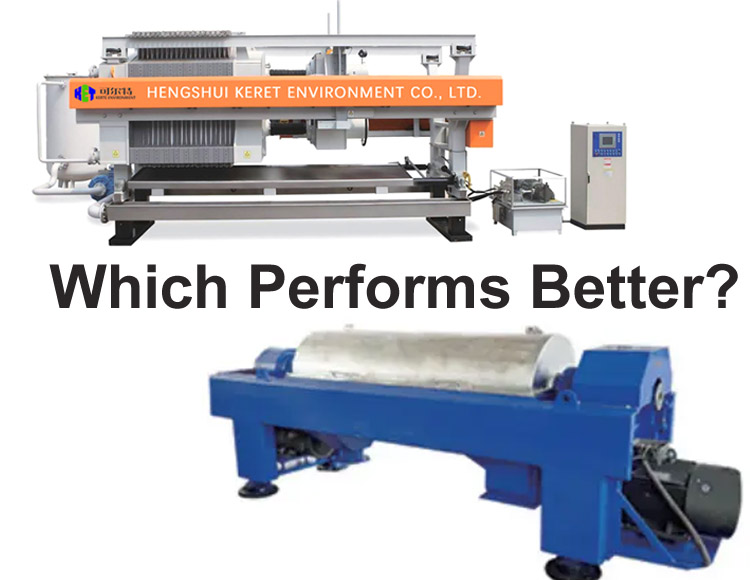
Filter press delivers lower moisture, lower energy consumption, and higher dewatering efficiency than horizontal centrifuges in industrial applications....
Tel & WhatsApp+8613932818978
Product Details
Choosing the right equipment for solid-liquid separation directly affects operating cost, energy consumption, and final product quality. At Kerte Filter Press, we often help customers compare a filter press with a horizontal centrifuge to find the best solution for mining, chemical, and wastewater treatment applications.
1. Working Principle
A filter press separates solids and liquids through pressure filtration. Slurry is pumped into the chambers, liquid passes through the filter cloth, and solids remain to form a dry filter cake. This process allows the filter press to achieve excellent separation performance, especially for fine particles and high-solid slurries.
A horizontal centrifuge uses high-speed centrifugal force to separate materials. The rotating drum continuously removes solids and liquid during operation. While this method supports continuous processing, separation efficiency may decrease when handling ultra-fine particles or sticky sludge.
2. Cake Moisture and Separation Efficiency
One major advantage of the filter press is lower cake moisture. After dewatering with a horizontal centrifuge, the cake moisture content is typically around 70–85%. In comparison, a filter press can reduce cake moisture to as low as 10%, depending on the material and process conditions.
Because of this performance, a filter press is widely used in mining tailings, chemical slurry, and industrial sludge treatment where dry solids and maximum water recovery are required. The filter press also produces cleaner filtrate, helping plants improve recycling efficiency and reduce disposal costs.
3. Energy Consumption
Energy consumption is another important factor. A horizontal centrifuge relies on high-speed rotation, which usually results in higher power consumption and increased maintenance requirements.
By comparison, a filter press operates with pressure filtration and generally consumes less energy during long-term operation. For many plants, using a filter press helps reduce operating costs while maintaining stable dewatering performance.
4. Application and Capacity
A horizontal centrifuge performs well in continuous large-flow operations with limited installation space. A filter press operates in batches, but it offers stronger adaptability for fine particles, tailings, sludge, and high-concentration slurry treatment.
At Kerte Filter Press, we provide customized filter press solutions designed for efficient dewatering, lower moisture content, and reliable long-term operation across demanding industries.